Living and working in compact quarters often narrows your daily physical range long before you notice the strain. In apartments under 500 square feet, the distance between bed, workstation, kitchen, and bathroom amounts to only a few dozen steps per transition. Over weeks and months, this lack of transit creates low daily step counts, often dropping below 2,500 steps unless you deliberately leave the building. The issue is not merely caloric expenditure; it is the absence of joint articulation through full ranges of motion, which leaves tissues adapted to the precise contours of your desk chair and couch.
Adapting your home environment for functional movement does not require clearing out furniture or building an elaborate gym. A space measuring roughly six feet by three feet-equal to the dimensions of a standard woven runner rug or bath towel-is sufficient to restore movement variability to your spine, hips, and lower limbs. By targeting the areas most susceptible to domestic immobility and structuring your movement around predictable daily triggers, you can maintain joint health and tissue tolerance within the footprint of an ordinary studio apartment.
Counteracting the Physical Effects of Domestic Confinement
Domestic confinement alters human biomechanics through repetitive micro-environments. When working in small spaces, your eyes adjust to short focal lengths, rarely focusing on objects more than ten or fifteen feet away. This sustained focal range encourages a forward head position, where the cervical spine moves anteriorly, increasing the effective load on the suboccipital and upper trapezius muscles. Simultaneously, the lack of ambient walking diminishes circulation in the deep veins of the calves, while the anterior hip capsule remains in persistent flexion for eight to ten hours per day.
Without deliberate intervention, this posture triggers reciprocal inhibition, a physiological process where chronically shortened hip flexors signal the gluteal muscles to relax. The result is dull lower-back discomfort, reduced pelvic control during weekend activities, and stiffness when standing up. Counteracting these patterns requires movements that generate axial elongation, open the hip joints, and create multidirectional spinal forces without requiring lateral clearance or overhead clearance exceeding standard eight-foot ceilings.
The solution starts with establishing an active zone that remains permanently accessible. If performing a stretch requires moving a coffee table, sliding two chairs, and rolling up a carpet, friction will defeat your routine within four days. Identify a single corridor of floor space alongside your bed or between your desk and the wall. Keep this zone clear of laundry hampers, shoes, and power cords so that transitioning from keyboard to floor takes under ten seconds.
Thoracic Mobility Drills for Screen Workers
Screen-focused work drives the mid-back into prolonged kyphosis, commonly known as hunching. Because the thoracic spine connects directly to the ribcage, stiffness here impairs shoulder elevation and reduces diaphragmatic breathing capacity, which can exacerbate fatigue. The following drills require only floor space and a sturdy household chair with a firm backrest.
Seated Rotational Opener
Sit sideways on a dining chair with your right hip pressed against the backrest. Keep your feet flat on the floor, spaced hip-width apart, knees tracked directly over your ankles to anchor your pelvis. Inhale to lengthen the crown of your head toward the ceiling, then exhale as you rotate your torso toward the chair back, gripping the frame with both hands. Use your arms to gently pull yourself deeper into the twist without letting your knees shift forward or backward. Hold the end range for three slow exhalations, release to neutral, and repeat six times before switching to the left side.
Wall Angels with Lumbar Flatting
Stand with your heels four inches away from an unobstructed wall. Lean your hips, upper back, and the back of your head firmly against the drywall. Flatten your lower back against the wall by engaging your deep abdominals, eliminating any gap between your waistband and the paint. Raise your arms to ninety degrees at the shoulders and elbows, forming a goalpost position against the wall. Slowly slide your wrists and elbows upward along the wall surface by four to six inches, ensuring your lower back does not arch away from the surface. Slide back down to the start position. Perform eight controlled repetitions, pausing for two seconds at the highest point of travel.
Prone Cobra with External Rotation
Lie face down on your floor clearance with your legs straight and the tops of your feet resting on the ground. Place your arms along your sides, palms facing down toward the floor. Draw your shoulder blades down toward your back pockets, then lift your chest, palms, and forehead two inches off the floor while keeping your gaze fixed directly downward to protect your neck. As you lift, rotate your hands outward so your thumbs point toward the ceiling. Squeeze the musculature between your shoulder blades for four seconds, lower slowly, and complete ten repetitions. If you experience discomfort in the front of your hips, place a folded towel beneath your pelvis for support.
Hip Flexor and Glute Activation in Limited Spaces
When you sit for extended periods, the psoas major, iliacus, and rectus femoris remain in shortened states, while the gluteus maximus and medius become under-recruited. Re-establishing baseline tone in the posterior chain requires isometric and short-lever movements that avoid large lunging steps or wide lateral bounds, making them well suited to rooms where you might otherwise kick baseboards or low tables.
To restore balance around the pelvis, combine passive stretching of the hip flexors with immediate active recruitment of the gluteal complex. Stretching a muscle without activating its antagonist produces short-lived mobility gains; combining them reinforces neurological control over the newly acquired joint range.
| Exercise Name | Primary Target | Required Space | Prescribed Volume |
|---|---|---|---|
| Half-Kneeling Posterior Tilt | Psoas and Rectus Femoris | 2 feet by 4 feet | 3 sets of 30-second holds per leg |
| Wall Isometric Glute Press | Gluteus Medius | 1 foot by 2 feet | 4 sets of 15 seconds per side |
| Single-Leg Glute Bridge | Gluteus Maximus and Hamstrings | 3 feet by 6 feet | 2 sets of 10 repetitions per leg |
| Isometric Quadruped Kickback | Gluteus Maximus and Core | 3 feet by 5 feet | 3 sets of 8 reps with 3-second hold |
Half-Kneeling Posterior Tilt
Place a folded towel under your right knee and step your left foot forward, creating ninety-degree angles at both knees. Avoid lunging forward into the front hip; maintain an upright torso stacked vertically over your back knee. Place your hands on your hips and deliberately tilt your pelvis backward, tucking your tailbone underneath you as if flattening your lower back against an imaginary surface. You will immediately feel tension along the front of your right thigh and hip. Squeeze your right glute firmly to deepen the stretch without shifting your torso forward. Maintain steady diaphragmatic breathing for thirty seconds, release for five seconds, and repeat three times before switching legs.
Wall Isometric Glute Press
Stand parallel to a clear wall, roughly six inches away. Stand on the leg furthest from the wall, keeping that knee slightly bent and your foot firmly planted with three points of contact: the heel, the big toe base, and the little toe base. Lift the inside leg to ninety degrees of hip flexion, placing the outside of that knee against the wall. Drive that knee sideways into the wall with steady effort, activating the hip abductors of both the standing and driving legs. Hold the contraction for fifteen seconds without allowing your torso to lean toward or away from the wall. Complete four repetitions per side to build lateral hip stability for standing desk work.
Micro-Breaks: Integrating Two-Minute Resets
Long blocks of seated concentration alter soft-tissue hydration. Intervertebral discs lose water content under continuous compression, and fascial layers adhere when static. Setting aside forty-five minutes for exercise at the end of the day cannot completely reverse eight hours of uninterrupted sitting. Introducing micro-breaks-intervals lasting between ninety and one hundred twenty seconds every forty-five to sixty minutes-preserves tissue hydration and breaks the cycle of static muscular fatigue.
The primary barrier to micro-breaks is decision fatigue. If you must choose what to do every time your alert sounds, you will dismiss the reminder to keep working. A standardized, low-friction sequence eliminates hesitation and fits inside any small workspace without requiring changes of clothing or footwear.
- Decompress the Spine: Stand tall with feet shoulder-width apart. Interlace your fingers, invert your palms toward the ceiling, and press upward while maintaining a soft bend in your knees. Inhale deeply through your nose for four seconds, feeling your ribs expand laterally. Exhale through pursed lips while reaching slightly higher, maintaining this tall posture for four full breath cycles.
- Mobilize the Hips: Place your hands on your desk or against a wall for light balance support. Lift your right knee toward your chest, rotate it outward to the side as far as possible without twisting your torso, drive the foot backward, and bring it back down to the center, drawing a complete circle with your hip joint. Complete five smooth circles in one direction, five in reverse, and repeat on the opposite leg.
- Activate the Calf Pump: Stand on the edge of a sturdy book, a door threshold, or flat on the floor. Raise your heels as high as possible over a two-second count, pause at the apex for one second to contract the gastrocnemius and soleus muscles, then lower under control for three seconds. Perform twelve repetitions to promote venous return from the lower extremities to the heart.
Tracking Weekly Consistency Without Special Equipment
Adherence to movement protocols in confined domestic environments drops rapidly when tracking relies on complex apps, battery-dependent wearables, or subscription software. These digital tools often introduce friction: notifications get muted during meetings, battery levels deplete, and screen-based interfaces invite distractions from work emails. Analog tracking inside your physical environment anchors the habit directly to the room where the behavior must occur.
A simple tracking system uses an index card taped to the edge of your desk monitor or beside your light switch. Draw a five-by-four grid representing the workweek days on the horizontal axis and four target movement intervals on the vertical axis: morning activation, midday mobility, mid-afternoon reset, and end-of-day recovery. Each time you finish a two-minute reset or targeted mobility drill, mark the corresponding box with a single diagonal slash. When you complete two slashes in the same block, cross them into an X to show completion of both mobility and postural resets.
Evaluate your consistency at the end of each week using a basic percentage formula: divide the total number of completed blocks by your weekly target. If your goal is twenty blocks per week (four blocks across five working days) and you complete fourteen, your consistency rate is 70 percent. Aim for a weekly baseline between 65 percent and 80 percent. This leaves room for unpredictable schedule shifts, urgent meetings, and fatigue without abandoning the routine altogether. If your completion falls below 60 percent for two consecutive weeks, reduce your daily target from four blocks to three rather than trying to double your efforts on weekends.
Common Mistakes to Avoid
Attempting mobility work in tight domestic spaces introduces specific errors that can cause joint irritation or routine abandonment. Recognizing these early preserves joint health and ensures long-term consistency.
- Over-stretching Cold Hamstrings: Bending over to touch your toes immediately after getting out of bed or rising from a desk puts high shear stress on unhydrated intervertebral discs. Focus first on active spinal extensions and controlled articular rotations before applying static tensile load to the posterior chain.
- Using Furniture for Unsupported Loads: Wheeled office chairs, lightweight hollow-core coffee tables, and unsecured bookshelves should never serve as anchors for balance drills or resistance points. Use solid door frames, load-bearing exterior walls, or structural kitchen counters.
- Aggressive Lumbar Hyperextension: When attempting to reverse a slouched posture, many people hinge entirely at the L5-S1 junction of the lower back rather than extending through the thoracic spine. Keep your lower ribs pulled gently downward toward your waistband to ensure the movement comes from your mid-back.
- Prioritizing Intensity Over Frequency: Performing a strenuous twenty-minute calisthenics routine once every three days does not offset the circulatory and postural effects of daily eight-hour sitting. Multiple short, low-intensity movement exposures distributed throughout the day yield superior tissue compliance.
Practical Next Steps for Your Daily Routine
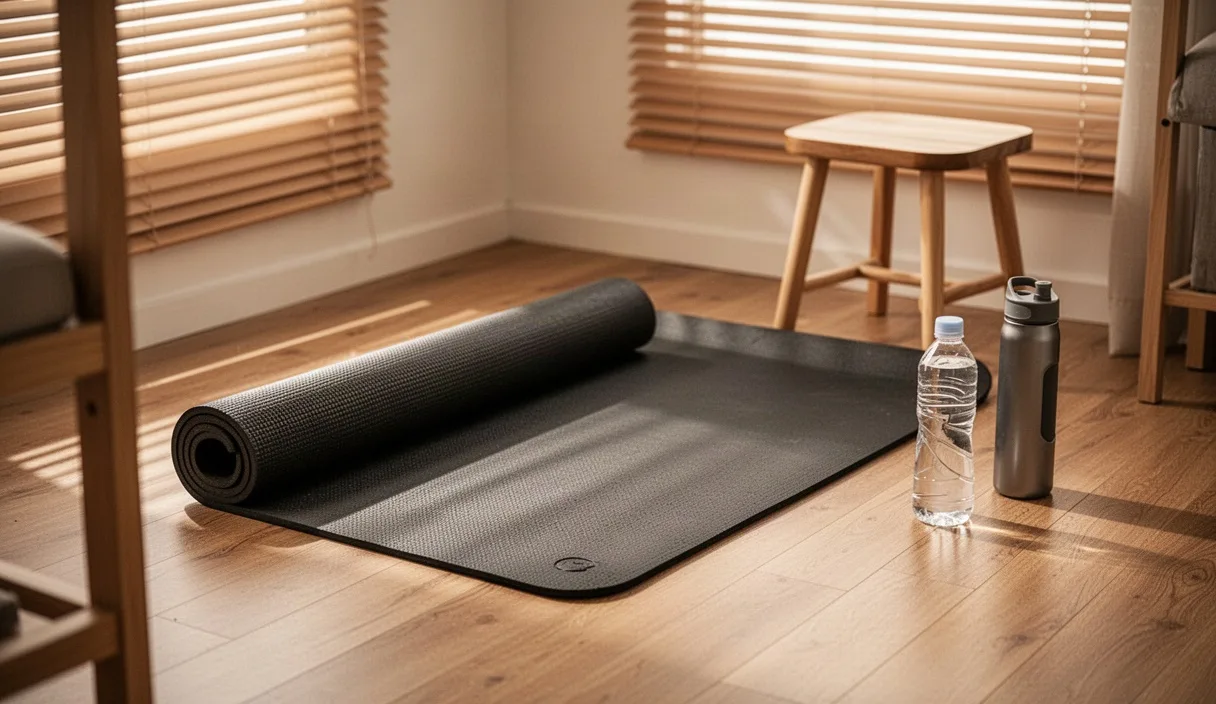
Begin tomorrow morning by clearing a dedicated movement space before opening your computer. Move any shoes, bags, or stray charging cables away from your selected six-by-three-foot floor strip so the physical path from your workstation is unobstructed. Place a single folded towel or thin mat in that spot to establish a clear boundary for daily mobility work.
Next, prepare your tracking card and tape it to your desk frame. Set a recurring, silent alarm on your workstation clock for forty-five minutes past the hour. When that prompt arrives, stand up immediately, step into your clear zone, and complete the three-step micro-break sequence without checking notifications or answering incoming messages during those two minutes.
Monitor how your joints and tissues respond across the first seven days. You should notice less mid-back tightness and reduced hip stiffness when transitioning out of your chair. If you experience sharp joint pain, numbness, tingling in your extremities, or existing structural spinal conditions, stop the movements immediately and consult a licensed physical therapist or sports medicine physician to receive a personalized assessment suited to your medical history.