Maintaining a healthy indoor environment during cold weather requires balancing two opposing hazards. When outdoor temperatures drop, central heating systems run for extended cycles, drastically reducing indoor relative humidity. This dry air irritates respiratory tracts, causes dry skin, and generates persistent static electricity. To counter these symptoms, many homeowners introduce humidifiers, add indoor plants, or limit fresh air intake to preserve ambient warmth.
Adding too much moisture to an enclosed space creates an equally severe problem. Excess humidity fuels rapid microbial growth, particularly dust mite colonies and toxic molds. Because warm indoor air migrates toward cold exterior surfaces, uncontrolled humidity causes hidden condensation inside wall cavities, behind furniture, and around window frames. Managing winter indoor climate is not about keeping the air as humid as possible, but rather maintaining a strict, measured threshold that supports human comfort without encouraging biological growth.
The Target Window for Winter Moisture
The ideal indoor relative humidity during the winter months lies between 32 percent and 44 percent. Maintaining this specific range keeps mucus membranes hydrated while remaining well below the threshold required for pests and fungi to thrive. Dust mites, microscopic arachnids that feed on shed human skin cells, cannot drink liquid water. Instead, they absorb moisture directly from the ambient air through specialized glands. When relative humidity consistently stays below 48 percent, dust mites dehydrate and cannot reproduce, leading to a natural die-off over several weeks.
Mold spores exist in almost all indoor spaces, resting dormant on surfaces such as drywall, wood framing, and ceiling tiles. These spores germinate when localized relative humidity against a surface exceeds 68 percent for 24 to 48 consecutive hours. Even if the center of a room reads 45 percent humidity, cold exterior walls create colder boundary layers of air. Because cold air holds less water vapor, the relative humidity directly against that chilly wall surface can easily spike past 70 percent, triggering spore growth.
As outdoor temperatures drop, homeowners must adjust their indoor humidity downward to prevent this surface condensation. The colder it is outside, the lower the indoor target must be. A single static indoor setting cannot protect a home across an entire heating season.
| Outdoor Temperature | Recommended Indoor Relative Humidity | Primary Risk of Exceeding Target |
|---|---|---|
| Above 35 degrees Fahrenheit | 40 percent to 44 percent | Window condensation on single-pane glass |
| 20 to 35 degrees Fahrenheit | 35 percent to 40 percent | Sill dampness, dust mite survival in bedding |
| 0 to 20 degrees Fahrenheit | 30 percent to 35 percent | Perimeter wall moisture, frost on double-pane edges |
| Below 0 degrees Fahrenheit | 25 percent to 30 percent | Wall cavity frost, structural wood rot |
How Cold Weather Heating Dries Indoor Air
Heating equipment does not destroy water vapor. The drying effect experienced in winter is a thermodynamic consequence of how air holds moisture at varying temperatures. Warmer air expands and can hold a substantially larger mass of water vapor than cold air before reaching its saturation point, known as the dew point. Relative humidity measures the amount of water vapor present in the air relative to the maximum amount that air could hold at its current temperature.
When outdoor air at 25 degrees Fahrenheit and 72 percent relative humidity enters a structure through natural infiltration or ventilation, it carries very little actual moisture by volume. As a furnace or heat pump warms that cold air to 68 degrees Fahrenheit, the total moisture content remains identical, but the air's holding capacity expands dramatically. Consequently, the relative humidity inside the home drops to roughly 18 percent. This dry air rapidly draws moisture out of anything porous: timber framing, hardwood flooring, leather furniture, house plants, and human skin.
Natural air exchange amplifies this problem through the stack effect. Heated indoor air is lighter and more buoyant than cold exterior air, so it rises toward the attic, exiting through recessed ceiling lights, attic hatches, and unsealed plumbing penetrations. As this warm air escapes, it creates a lower-pressure zone in the lower levels of the house, pulling cold, bone-dry outdoor air through basement rim joists, electrical outlets, and foundation sills. Homes with high air-leakage rates experience constant replacement of indoor air with dry outdoor air, driving indoor moisture levels down to single digits during prolonged freezes.
Risks of Oversaturation: Mold Growth and Condensation
When occupants try to resolve extreme dryness by running unmonitored humidifiers, they often oversaturate the building envelope. The primary hazard is condensation at thermal bridges. Thermal bridges are locations where the building frame conducts heat outward faster than surrounding insulated areas, such as window frames, corners where exterior walls meet, and metal fasteners. When humid indoor air contacts these cold spots, its temperature drops below its dew point, and liquid water droplets form on the surface.
Persistent surface moisture creates the exact conditions needed for common indoor mold species, such as Aspergillus, Cladosporium, and Penicillium. These molds feed on organic compounds found in the cellulose backing of drywall, wallpaper paste, and dust deposits on baseboards. Mold growth does not just ruin building finishes; the spores and volatile organic compounds released into the air can irritate respiratory passages, trigger asthma attacks, and cause chronic allergic responses. If mold growth spreads across an area larger than 10 square feet, remediation typically requires containment protocols and evaluation by an indoor environmental professional.
Dust mites take advantage of high humidity in different zones of the house. They concentrate where humans spend long periods: mattresses, pillows, upholstered sofas, and heavy rugs. Dust mites do not need visible liquid water to survive; an ambient relative humidity consistently over 52 percent provides enough water vapor for their survival. Their waste particles contain potent proteins that cause common indoor allergen symptoms, including congestion, sneezing, and irritated eyes.
- Window perimeter pooling: Water collects on glass, runs down onto wooden sills, and rots window trim while cultivating black mold lines around silicone seals.
- Hidden exterior wall dampness: Moisture migrates through drywall and condenses on cold outer sheathing, saturating fiberglass insulation and reducing its insulating value.
- Furniture microclimates: Dressers, headboards, and couches pushed against exterior walls block room airflow, creating pockets of cold, stagnant, high-humidity air where mold colonies form unseen.
Selecting Between Evaporative and Ultrasonic Humidifiers
Choosing the correct humidifier design directly affects indoor air cleanliness and moisture stability. The two most common residential types, evaporative wicking humidifiers and ultrasonic humidifiers, introduce moisture using distinct physical principles.
Evaporative humidifiers use an internal fan to draw ambient room air through an absorbent, moistened wick or filter. As the dry air passes through the wet fibers, water evaporates naturally into the airstream. This method provides an inherent safety advantage: evaporation slows naturally as the relative humidity of the room rises. Once ambient air approaches 50 percent humidity, the rate of evaporation decreases significantly, reducing the risk of accidental oversaturation. The wick also traps larger minerals present in the water supply, preventing them from scattering into the living space.
Ultrasonic humidifiers use a small metal diaphragm vibrating at high frequencies to break water into microscopic liquid droplets, which a small fan disperses as a visible cool or warm fog. Because ultrasonic units atomize the entire water volume rather than evaporating it, they push every substance dissolved in the reservoir into the air. If filled with standard tap water, an ultrasonic unit releases dissolved calcium, magnesium, and other minerals, which settle across surfaces as a fine white powder and can be inhaled into the lungs. They can also force room humidity far past safe limits because the mechanical nebulization continues regardless of current room saturation.
| Feature | Evaporative Humidifier | Ultrasonic Humidifier |
|---|---|---|
| Humidification Mechanism | Air pulled through wet porous wick | High-frequency ultrasonic vibration |
| Risk of Mineral Dust | Low: minerals remain trapped in wick | High: requires distilled or demineralized water |
| Over-saturation Potential | Low: self-limits as air nears saturation | High: pushes mist continuously until shut off |
| Maintenance Needs | Regular wick replacements, scale cleaning | Frequent reservoir disinfection to prevent slime |
| Noise Profile | Moderate fan noise across various speeds | Nearly silent operation with quiet hum |
Daily Ventilation Techniques Without Losing Heat
Many homeowners keep windows tightly sealed all winter to preserve warmth. However, daily human activities such as breathing, cooking, showering, and washing dishes release roughly 2 to 4 gallons of water vapor into the air each day. Without planned air exchanges, this moisture stays trapped inside modern, tight building envelopes. The goal is to remove this excess water vapor without wasting the energy used to heat the structure.
Shock ventilation, commonly practiced in Central Europe under the name Stoßlüften, is the most efficient way to exchange indoor air without significant heat loss. Instead of leaving a single window cracked open for hours, which steadily bleeds heat from walls and floors, open several windows wide on opposite sides of the living space for 4 to 6 minutes. This cross-breeze rapidly sweeps out the moist, stale air, replacing it with dry, cold exterior air.
Because the exchange happens quickly, the heavy thermal mass of the home, including furniture, concrete subfloors, and plaster walls, stays warm. Once the windows are closed, this stored heat brings the fresh, dry incoming air up to comfortable temperatures within minutes. Perform this cross-ventilation two to three times daily, particularly after waking and after evening cooking.
- Run mechanical kitchen exhaust hoods: Turn on externally vented exhaust fans whenever boiling water or using gas burners. Keep the fan running for 5 minutes after cooking ends to clear residual moisture.
- Manage bathroom steam at the source: Run the bathroom exhaust fan before turning on the shower, and leave it running for 20 minutes afterward. Ensure the fan exhausts directly outdoors rather than into an attic space.
- Keep interior doors ajar: Closed bedroom doors overnight trap moisture from breathing, driving localized humidity in small rooms above 60 percent by morning. Leaving doors partially open allows vapor to disperse evenly through the home.
- Utilize mechanical ventilation systems: If the home features a Heat Recovery Ventilator (HRV) or Energy Recovery Ventilator (ERV), ensure the filters are clean and the continuous run mode is active. An HRV transfers sensible heat from outgoing stale air into incoming fresh air, recovering roughly 70 percent to 80 percent of the energy while expelling moisture.
Common Mistakes
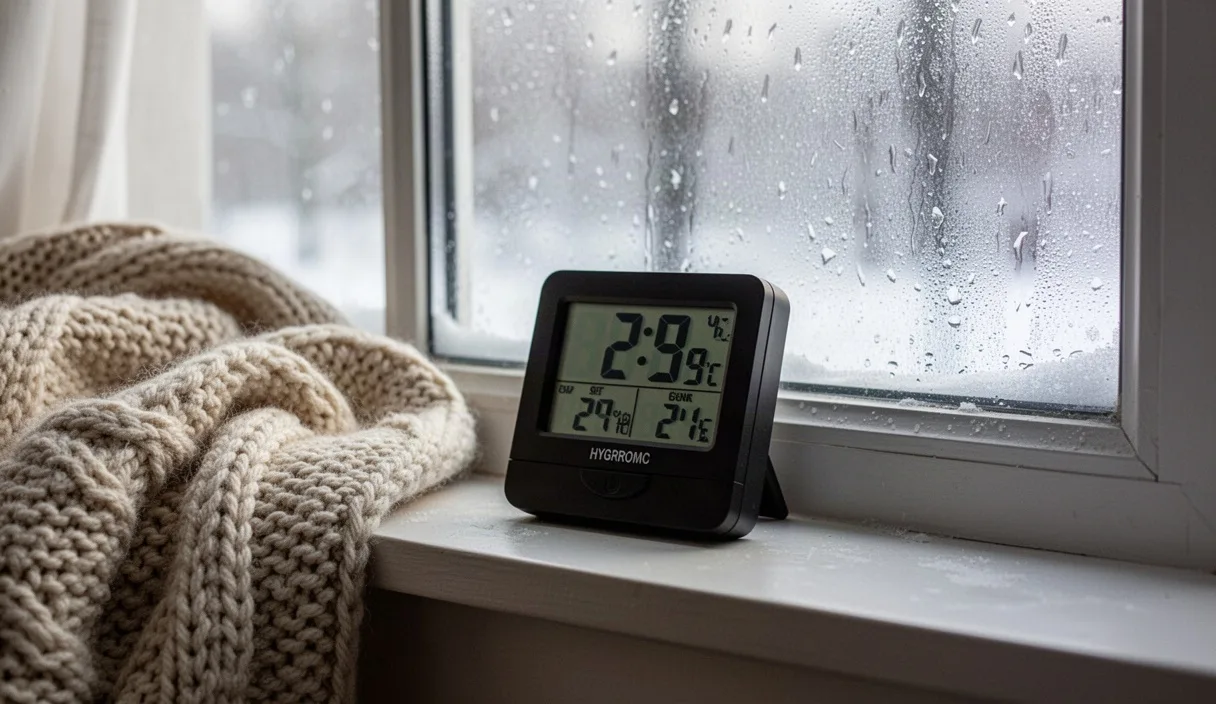
A frequent error is relying on the built-in humidistat on a portable humidifier. These sensors measure the air directly adjacent to the moist output port of the machine, routinely showing readings that are 10 percent to 15 percent higher than the rest of the room. To get an accurate reading, place a standalone, calibrated digital hygrometer on an interior wall at eye level, at least 6 feet away from any humidifier, heating register, or exterior door.
Another common mistake is air-drying clothes on indoor laundry racks during cold spells without adequate ventilation. A single load of wet laundry can release more than a half-gallon of water into the living area as it dries. While this may seem like an easy way to humidify dry air, it releases moisture without any regulation, driving localized humidity in laundry spaces into the mold-growth zone.
Homeowners often forget to pull furniture away from exterior walls during prolonged freezing weather. Pushing a dense sofa, mattress, or bookcase tightly against an uninsulated exterior wall blocks the circulation of warm room air. This creates a cold microclimate where water vapor readily condenses, fostering mold growth that often remains hidden until the furniture is moved in the spring.
Taking Action
Start by assessing your home's current moisture profile. Purchase two or three reliable digital hygrometers and position them in key zones: the primary bedroom, the living room, and the basement or lowest living level. Observe the baseline readings over a 48-hour period, noting how the values shift during cooking, showering, and across night-time heating cycles.
If relative humidity readings consistently fall below 30 percent, install an evaporative humidifier sized appropriately for the square footage of the space, filling it with clean water and tracking the hygrometer to keep levels between 35 percent and 40 percent. If your readings consistently exceed 45 percent during freezing conditions, suspend active humidification, implement shock ventilation twice a day, and inspect window tracks and exterior wall corners for traces of moisture.
If condensation or mold growth persists despite careful ventilation and humidity control, consult a qualified HVAC contractor or an energy auditor. Persistent moisture problems often point to hidden building defects, such as uninsulated wall cavities, improper duct routing, leaky plumbing, or an oversized heating system that short-cycles and fails to regulate air circulation correctly.